(The full archive of Neville Coleman's ID Crisis columns is available on disk from )
A selection of Neville Coleman's Marine Life books can be found here.
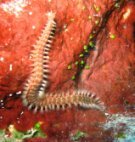 |
FROM Sandra Schwarz LOCATION: Rottnest Island, WA
ID - FAMILY: Amphinomidae COMMON NAME: Bristle Worm SCIENTIFIC NAME: Pherecardia sp. REMARKS: Bristle worms are common throughout the IndoPacific and are also known as fire worms: as they have venomous bristles. Image shows all the features. I have not found this species yet, although it is known and has been published. |
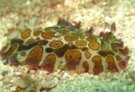 |
FROM Pino and Paul LOCATION: Koh Man Wichia, Pattaya, Thailand
ID - FAMILY: Dendrodorididae COMMON NAME: Rainfords Dendrodoris SCIENTIFIC NAME: Dendrodoris rainfordi REMARKS: This species was originally recognised and described in 1932 by one of Australias first modern taxonomists that actually used coloured paintings in her books. This species is now known to also occur in Thailand and Malaysia. It grows to 170 mm and inhabits sandy rubble bottom. |
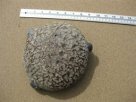 |
FROM Gary Dyer LOCATION: Phillip Island, Victoria
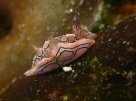
ID - FAMILY: ? COMMON NAME: Port Phillip Mystery Critter SCIENTIFIC NAME: ? REMARKS: I have never seen anything like it. I guess the only way to know is to cut through a section and check on the internal system. It does not appear to be the species of sponge in Karens book. I could only suggest that it is something from deepwater that might have been tossed over by trawlers? |
 |
FROM Jerry and Debbie LOCATION: South Pinnacle, Narcondam Island, Andaman Islands
ID - FAMILY: Gastropteridae COMMON NAME: Psychedelic Sagminopteron SCIENTIFIC NAME: Sagminopteron psychedelicum REMARKS: Very difficult to recognise in natural habitat this little slug has an amazing pattern and an even more amazing name. It ranges from the Red sea to Lord Howe Island in the South Pacific and grows to only 12 mm. |
 |
FROM Beth Tierney LOCATION: Zanzibar
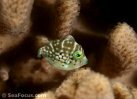
ID - FAMILY: Monacanthidae COMMON NAME: Mimic Leatherjacket-Filefish (juvenile) SCIENTIFIC NAME: Paraluteres prionurus REMARKS: Even though your one is so small, it has many characteristics of the adult colour pattern. This species mimics the Clown Toby, but the Mimic Filefish is easy to distinguish by the spine on its first dorsal, similar to all leatherjackets and filefish. It reaches 100 mm when fully grown and may be seen swimming in small groups. |
 |
FROM Michael Cupitt LOCATION: Reef Magic Pontoon on Moore Reef, GBR
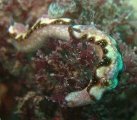
ID - FAMILY: Chromodorididae COMMON NAME: Godeffroys Risbecia SCIENTIFIC NAME: Risbecia godeffroyana REMARKS: Your two are trailing, which is a common trait amongst Risbecias. This species grows to 50 mm and is found from Hawaii to Tahiti. |
 |
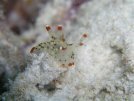
FROM Sophia M. L. Chan. LOCATION: ?
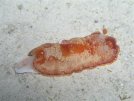
ID - FAMILY: Chromodorididae COMMON NAME: Reticulated Chromodoris SCIENTIFIC NAME: Chromodoris cf. reticulata REMARKS: This species is very variable and yours appears to be very close to this species. |
 |
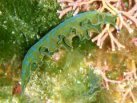
FROM Sophia M. L. Chan LOCATION: ?
ID - FAMILY: Polyceridae COMMON NAME: Malaysian Thecacera SCIENTIFIC NAME: Thecacera sp. REMARKS: I have not seen this species, nor can I find any visual reference to it. I expect that it is an undescribed species. Congratulations on your find. |
 |
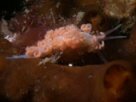
FROM Michael Smith LOCATION: Emily Bay, Norfolk Island
ID - FAMILY: Placobranchidae COMMON NAME: Blue-Spotted Elysia SCIENTIFIC NAME: Elysia sp. REMARKS: This species of sapsucker (opisthobranch mollusc) is an undescribed species which I first found at Coffs Harbour New South Wales in 1985. It is also known from Byron Bay Lord Howe Island and Norfolk Island and often occurs in large numbers. It grows to 20 mm and similar to other opisthobranchs, it is hermaphroditic. |
 |
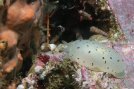
FROM Gerardo Arriaga (Jerry) LOCATION: Torpedo Alley, Rinca Island, Komodo
ID - FAMILY: Goniodorididae COMMON NAME: Komodo Trapania SCIENTIFIC NAME: Trapania sp. REMARKS: Takako Uno has found a specimen similar to this in Indonesia. However, I am not a nudibranch taxonomist and this species may have fine white markings ( as yours), or big blobs of white markings, and until a taxonomist can check with images against the specimens in hand, we shall just have to wait and see? |
 |
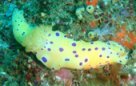
FROM Simon Hartley LOCATION: Julian Rocks, Byron Bay, New South Wales
ID - FAMILY: Pleurobranchidae COMMON NAME: Matens Berthella SCIENTIFIC NAME: Berthella martensi REMARKS: A far as I can determine this species has been recorded from Julian Rocks area before. It is a widespread species growing to 55 mm and ranging from South Africa to Mexico. It feeds on sponges and ascidians and may be seen during the daytime or night time. |
 |
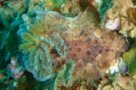
FROM Simon Hartley LOCATION: Julian Rocks, Byron Bay, New South Wales
ID - FAMILY: Chromodorididae COMMON NAME: Shorttailed Ceratosoma SCIENTIFIC NAME: Ceratosoma brevicaudatum REMARKS: Well known all along the southern coast of Australia it is known from northern New South Wales and the Julian Rock area. It grows to 100 mm and feeds on sponges. |
 |
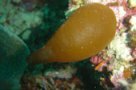
FROM Simon Hartley LOCATION: Julian Rocks, Byron Bay, New South Wales
ID - FAMILY: Dendrodorididae COMMON NAME: Mushroomed Dendrodoris SCIENTIFIC NAME: Dendrodoris sp. REMARKS: This appears to be an undescribed species. It is a very peculiar species with very well developed tubercules that appear to have a skirted base. To my knowledge it has only been recorded from the Philippines. Congratulations. |
 |
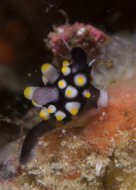
FROM Josef Schauberger LOCATION: Philippines/Bohol
ID - FAMILY: Leucettidae COMMON NAME: Gourd Sponge SCIENTIFIC NAME: Pericharax sp. REMARKS: The reason you were not able to see another aperture (similar to a solitary ascidian) is that the organism is a sponge. This little sponge appears to belong to family of calcareous sponges that have spicules comprised of lime (calcium carbonate) with no spongin fibres in their skeletons. Most species are karki, or bright yellow. |
 |
FROM David & Debi Henshaw LOCATION: Lembeh
ID - FAMILY: Ovulidae COMMON NAME: Egg Cowry SCIENTIFIC NAME: Ovula ovum REMARKS: This is a very juvenile form. The large pustulelike balloons are thought to mimic opisthobranchs and so protect the young from predation by impersonating bad tasting nudibranchs, or side gilled slugs. In general, Ovula ovum lays its eggs onto its food source, the Leather Corals. |
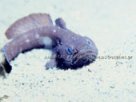 |
FROM Andreas Paraskevopoulos LOCATION: Seririt, North Bali
ID - FAMILY: Gobiidae COMMON NAME: Coca Cola Goby SCIENTIFIC NAME: Callogobius sp. REMARKS: Rudie does not know this species either and gives a tentative identification to genus. He thinks that is is possibly an undescribed species. So, congratulations! |
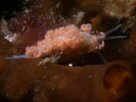 |
FROM Nic Matich LOCATION: Perth Wreck, Albany
ID - FAMILY: Facelinidae COMMON NAME: Made-up Phyllodesmium SCIENTIFIC NAME: Phyllodesmium serratum REMARKS: Occurs from the United Arab Emirates to Sulawesi, Japan to north west Australia to south across southern Australia and around to Queensland. It feeds on a number of gorgonian sea fans and soft corals such as Clavularia flava in Victoria. It grows to 30 mm and there are a number of colour variations on page 283/1 to 8 NUDIBRANCHS ENCYCLOPEDIA. |
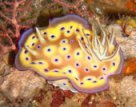 |
FROM Peter Clerke LOCATION: Tulamben, Bali
ID - FAMILY: Chromodorididae COMMON NAME: Kunes Chromodoris SCIENTIFIC NAME: Chromodoris kunei REMARKS: This species is variable but can be separated from C.geminus by the absence of the white edged mantle line. Kunes Chromodoris is distributed from South Africa to Malaysia and across to Tonga in the South Pacific. It grows to 40 mm and feeds on sponges. |
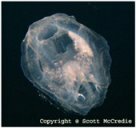 |
FROM Scott McCreadie LOCATION: Chumporn Pinnacle, Thailand
ID - FAMILY: Phronimidae COMMON NAME: Hermit-Screw Amphipod SCIENTIFIC NAME: Phronima sedentaria REMARKS: This little amphipod is often called a Barrel Shrimp because it takes up residence in the bell of a pelagic ascidian. It is widely distributed in the plankton in both tropical and temperate seas. The female grows to around 25 mm and can propel its residence by rapid movements of the thorax, causing the its home to gyrate around in unbalanced screw-like motions. |
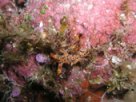 |
FROM Sophia M.L. Chan LOCATION: Sipadan Island
ID - FAMILY: Dendronotidae COMMON NAME: Spikey Dendronotus SCIENTIFIC NAME: Dendronotus sp. REMARKS: This species appears to be uncommon. I only have records from the Philippines and Indonesia. This family of nudibranchs was not thought to inhabit the southern hemisphere until a few years ago. Congratulations, it is a very good discovery. |
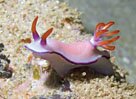 |
FROM Nigel Marsh. LOCATION: Exmouth, WA, Aust.
ID - FAMILY: Chromodorididae COMMON NAME: Exmouth hypselodoris sp. SCIENTIFIC NAME: Hypselodoris sp. REMARKS: This is an excellent critter and as far as I can determine from my extensive references it is still undescribed and appears to be a new species. I found a similar species there in 1972 which I named EXMOUTH CHROMODORIS at the time. |
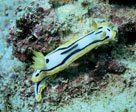 |
FROM Nigel Marsh. LOCATION: Exmouth, WA, Aust.
ID - FAMILY: Chromodoridae COMMON NAME: Strigate Chromodoris SCIENTIFIC NAME: Chromodoris strigata REMARKS: As far as I can determine your specimen has all the external features of this variable species even though the colors and pattern do not appear exactly as identified species in most popular publications. |
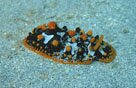 |
FROM Nigel Marsh. LOCATION: Exmouth, WA, Aust.
ID - FAMILY: Phyllidiidae COMMON NAME: Ocellate Phyllidia SCIENTIFIC NAME: Phyllidia ocellata REMARKS: At this point in time I believe all the unbelievable forms in WA are still being determined as this species. It has an amazing range of color and form variations, the most of any nudibranch I know. This is why I gave it such a wide coverage in 1001 NUDIBRANCHS. |
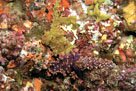 |
FROM Aaron Smith. LOCATION: Nth Stradbroke, QLD, Aust.
ID - FAMILY: Chromodorididae COMMON NAME: Divine Ceratosoma SCIENTIFIC NAME: Ceratosoma moloch REMARKS: Dr. Richard Willan had known of them and kindly supplied the identification. This species is not common at any particular place and ranges from Okinawa to the Solomon Islands and on to the Great Barrier Reef and Queensland's offshore reefs. It grows to 140mm and feeds on sponges. |
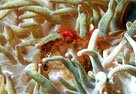 |
FROM Alison Smith. LOCATION: Nth Stradbroke, QLD, Aust.
ID - COMMON NAME: Orangutan crab SCIENTIFIC NAME: Achaeus japonicus REMARKS: This spider crab is often found in sea anemones, various species of bubble corals and mushroom corals. The body is covered long hairs and a matting of fine orange algae. It is found from Japan to Malaysia and Indonesia, Papua New Guinea, Australia and Fiji. |
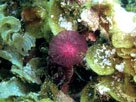 |
FROM Peter Zagol. LOCATION: Perhentians Islands, Malaysia.
ID - FAMILY: Phloeodictyidae COMMON NAME: Puff Ball Sponge SCIENTIFIC NAME: Oceanapia sagitaria REMARKS: Found from Malaysia to the Maldives and across to PNG, Australia and the Great Barrier Reef. This very unusually fragile puff- ball-topped long stalked sponge gives little indication to its ancestry. It is generally found in sheltered lagoons or on silty slopes and grows to around 80 mm. Colour is similar across its range. |
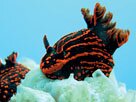 |
FROM Matt. LOCATION: Upper Exmouth Gulf, WA, Aust.
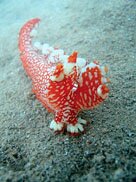
ID - FAMILY: Polyceridae COMMON NAME: Dusky Nembrotha SCIENTIFIC NAME: Nembrotha kubaryana REMARKS: This colour form is the same as that found in Dampier. This species grows to around 70 mm and ranges from South Africa to Okinawa the Philippines and across to Papua New Guinea to Australia. It feeds on ascidians. |
 |
FROM Matt. LOCATION: Upper Exmouth Gulf, WA, Aust.
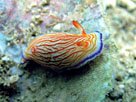
ID - FAMILY: Bornellidae COMMON NAME: Rowlands Bornella SCIENTIFIC NAME: Bornella sp. REMARKS: The first Western Australian images of this undescribed species were taken by Wally Rowlands in 1988 off Dampier, WA. It has been found in a number of other areas and is awaiting description. |
 |
FROM Matt. LOCATION: Upper Exmouth Gulf, WA, Aust.
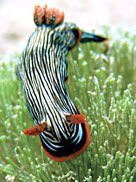
ID - FAMILY: Chromodorididae COMMON NAME: Scribbled Chromodoris SCIENTIFIC NAME: Chromodoris sp. REMARKS: A brand new species first discovered by Takamasa Tonozuka from Dive and Dives in Bali Indonesia this species is now known from Malaysia, the Philippines and Papua New Guinea. Yours is the first record I have seen from Australia and it is an excellent image of the species. |
 |
FROM Matt. LOCATION: Upper Exmouth Gulf, WA, Aust.
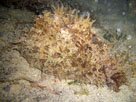
ID - FAMILY: Chromodorididae COMMON NAME: Striate Chromodoris SCIENTIFIC NAME: Chromodoris striatella REMARKS: Known across Northern Australia, Indonesia and Singapore to New Caledonia this species grows to around 40 mm and feeds on sponges. |
 |
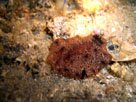
FROM Herbert Kollmann. LOCATION: Ship Rock, NSW, Aust.
ID - FAMILY: Aplysiidae COMMON NAME: Eared Sea Hare SCIENTIFIC NAME: Dolabella auricularia REMARKS: This species grows to around 300 mm and is known from the Red Sea to Japan and Australia and across to the Galapagos Islands. Often found in muddy substrates and algae covered rubble it feeds on algae and can squirt out purple ink when disturbed. |
 |
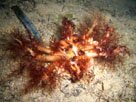
FROM Herbert Kollmann. LOCATION: Ship Rock, NSW, Aust.
ID - FAMILY: Dorididae COMMON NAME: Large-gilled Hoplodoris SCIENTIFIC NAME: Hoplodoris grandiflora REMARKS: Distributed across the Asia/Indo Pacific region this species grows to 60 mm. It comes in several forms of brown with white and brown pustules and can be confused with its relative from southern waters H. nodulosa. |
 |
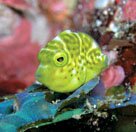
FROM Herbert Kollmann. LOCATION: Ship Rock, NSW, Aust.
ID - COMMON NAME: Burrowing Sea Cucumber REMARKS: There are several families of sea cucumbers which burrow in the substrate and extend their feeding tentacles into the water column to catch plankton. Your specimen is so buried and there are not enough features for me to make an accurate identification. |
 |
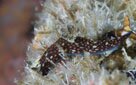
FROM Shaff. LOCATION: South male' atoll, 'Embudhu Express'
ID - FAMILY: Monacanthidae COMMON NAME: Mimic Filefish SCIENTIFIC NAME: Paraluteres prionurus REMARKS: You were very close in your ID, it is a juvenile of this species. This species is found across the IndoPacific and is a mimic of the Saddled Pufferfish Canthigaster valentini. |
 |
FROM Chris von Damm. LOCATION: Similan Islands off the West Coast of Thailand.
ID - FAMILY: Polyceridae COMMON NAME: Livingstones Nembrotha SCIENTIFIC NAME: Nembrotha livingstonei REMARKS: This species is found from Japan to Indonesia to Australia and the south Pacific. It grows to 40mm and is quite variable in colour. There is a characteristic daggerlike white blaze on the forehead of mature specimens. |
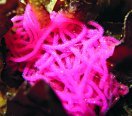 |
FROM David Evans. LOCATION: Portsea Pier, Vic, Aust.
ID - FAMILY: Aplysiidae COMMON NAME: Sea Hare SCIENTIFIC NAME: Aplysia sp. REMARKS: These spaghetti-like strings are the eggs of a sea hare that has been feeding on red algae. Sea hares only live a short time and generally appear as seasonal visitors that inhabit Port Phillip Bay. |
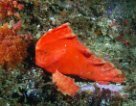 |
FROM Nigel Marsh. LOCATION: Byron Bay.
ID - FAMILY: Pataecidae COMMON NAME: Red Indian Fish SCIENTIFIC NAME: Pataecus fronto REMARKS: Ranging from southern Queensland south and around to Exmouth Gulf in Western Australia this species is rarely seen by divers. They generally inhabit reefy areas where there are large similarly coloured sponges and stay in that area for some time. The species grows to 250 mm. |
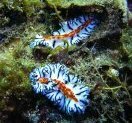 |
FROM Brandon Darby.
ID - FAMILY: Euryleptidae COMMON NAME: Virgula Maritigrella Flatworm SCIENTIFIC NAME: Maritigrella virgulata REMARKS: Known from Heron Island on the Great Barrier Reef and the Coral Sea this species (like most flatworms) is very variable in pattern. Yours is the first record I have for the species being in WA.There is so much to learn and so few to do the work. |
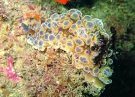 |
FROM Nic Rewitt. LOCATION: Botany Bay, Bare Island, depth 9m
ID - FAMILY: Dendrodorididae COMMON NAME: Gunnamatta Dendrodoris SCIENTIFIC NAME: Dendrodoris gunnamatta REMARKS: Found in NSW this species grows to around 45mm. It feeds on sponges and due to its drab colours is not seen by many divers. You are to be congratulated I have only ever found two. |
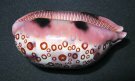 |
FROM Nic Rewitt. LOCATION: Fiji
ID - FAMILY: Cypraeidae COMMON NAME: Eyed Cowry SCIENTIFIC NAME: Cyprea argus REMARKS: This quite a large cowry and grows up to 100mm and is found across the Indo Pacific. Not very many divers ever see them alive because like most cowries they only come out of their caves and beneath dense coral growth at night. |
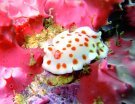 |
FROM Nic Rewitt. LOCATION: Found at Magic Point, depth 16m
ID - FAMILY: Chromodorididae COMMON NAME: Tasmanian Chromodoris SCIENTIFIC NAME: Chromodoris tasmanensis REMARKS: This species only occurs in southern Australia where it is found in Tasmania, NSW, and Victoria. It grows to around 60mm and is generally seen on its pink food sponge Darwinella rosea. |
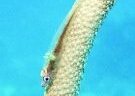 |
FROM Andrew Hosking. LOCATION: Thetfort Reef GBR, The Wall, depth 10m resting on whip coral
ID - FAMILY: Gobiidae COMMON NAME: Large Whip Goby SCIENTIFIC NAME: Bryaninops amplus REMARKS: This small commensal goby grows to 50mm and can be found in association with gorgonian sea whips and gorgonian sea fans , generally in areas of strong current. The fish may spend their entire lives on the host, even laying their eggs on it. |
|
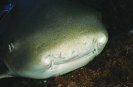 |
FROM Mark Gray LOCATION: Julian Rocks, Byron Bay.
ID - REMARKS: I am not able to make out the Leopard shark parasites. |
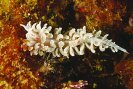 |
FROM Mark Gray LOCATION: Julian Rocks, Byron Bay.
ID - FAMILY: Facelinidae COMMON NAME: Cryptic Phyllodesmium SCIENTIFIC NAME: Phyllodesmium crypticum REMARKS: Ranges from the Red Sea to Japan, Indonesia and down to NSW and feeds on Xenia sp.soft corals. It is not commonly observed and since I found my first one in 1972 I have only found 3 others. |
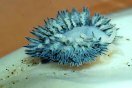 |
FROM Gerard Braithwaite LOCATION: Byron Bay, strong northerly wind.
ID - FAMILY: Fionidae COMMON NAME: Pinnate Fiona SCIENTIFIC NAME: Fiona pinnata REMARKS: Your unusual discovery lives out its entire life just under the surface of the ocean. It has a cosmopolitan distribution and is generally found on driftwood or old cuttlefish bones that have lots of goose barnacles which are its main food. It grows to 20 mm and may be grey or blue in colour. |
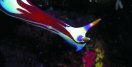 |
FROM Brandon Darby. LOCATION: Abrolhos Islands
ID - FAMILY: Polyceridae COMMON NAME: Red-Gilled Nembrotha SCIENTIFIC NAME: Nembrotha rutilans REMARKS: Common in north west Australia, this species grows to 60mm and feeds on ascidians. |
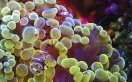 |
FROM Brandon Darby. LOCATION: Abrolhos Islands
ID - FAMILY: Palaemonidae COMMON NAME: Commensal Shrimp SCIENTIFIC NAME: Periclimenes sp. REMARKS: This is one of the many commensal shrimps which live in coral and sea anemones throughout the Asia/Indo Pacific region. Unfortunately I am not able to see the tail pattern or much of the hump pattern so I am unable to make an accurate identification beyond genus. |
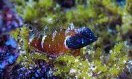 |
FROM Brandon Darby. LOCATION: Abrolhos Islands
ID - FAMILY: Tripterygiidae COMMON NAME: Black-Throated Three Fin SCIENTIFIC NAME: Helcogramma decurrens REMARKS: Your image appears to be a male of this species. It grows to 70 mm and ranges from south west Australia around to South Australia. |
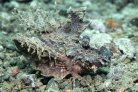 |
FROM Kylie Kenny. LOCATION: Trip on Paradise Sport
ID - FAMILY: Scorpaenidae COMMON NAME: Ghoul SCIENTIFIC NAME: Inimicus sp. REMARKS: There are two species that range into PNG and they can only be reliably separated visually by the colour pattern on the underside of the pectoral fin. |
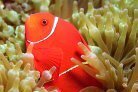 |
FROM Kylie Kenny. LOCATION: Trip on Paradise Sport
ID - FAMILY: Pomacentridae COMMON NAME: Spinecheek Anemonefish SCIENTIFIC NAME: Premnas biaculeatus REMARKS: Found across the Asia/Pacific this is a very easily recognized species which inhabits bulb tentacle sea anemones and grows to around 8 cm. Congratulations on your up coming marriage. |
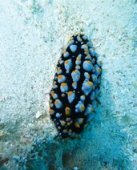 |
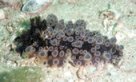
FROM Nic Rewitt. LOCATION: Fiji in 12m on the sandy bottom.
ID - FAMILY: Phyllidiidae COMMON NAME: Varicose phyllidia SCIENTIFIC NAME: Phyllidia varicosa REMARKS: It appears to me that your critter represents this species more than it does P.carlsonhoffi as both are found in Fiji and the former has a great deal more pustules. |
 |
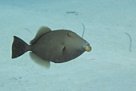
FROM Paul Wickham. LOCATION: Shiprock, Hacking River, Sydney in 16m on the sandy bottom.
ID - FAMILY: Dendrodorididae COMMON NAME: Gunnamatta dendrodoris SCIENTIFIC NAME: Dendrodoris gunnamatta REMARKS: Rarely observed by most divers over it's distribution this species grows to around 45 mm and occurs in southern New South Wales, Australia. |
 |
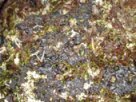
FROM Karen Willshaw. LOCATION Cocos (Keeling) Islands
ID - FAMILY: Balistidae COMMON NAME: Bridled triggerfish SCIENTIFIC NAMES: Sufflamen fraenatus REMARKS: It appears your fish has a growth caused by some unknown process on its lower lip. Its certainly not eggs. It is more likely the fish is skittish because its extra wary due to the distress caused by the growth. Fish with isopod parasites are also very difficult to get shots in most cases. |
 |
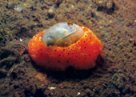
FROM Andrew G. LOCATION Hideaway Island, Vanuatu on the reef flats.
ID - We know so little about worm fauna across the Asia/Indo-Pacific area as there arent many taxonomists and there are so many different worms and few people take their pictures because most groups (with the exception of flatworms) live in holes or tubes and out of sight. I can find no reference at all to your intertidal, easily found, common worms at this stage. |
 |
FROM Gary Whitby & Nicole Howard. LOCATION: Swan River, WA in shallow water, 6-8m
ID - FAMILY: Velutinidae COMMON NAME: Southern lamellarid SCIENTIFIC NAME: Lamellaria australis REMARKS: Your critter is this species with the entire top of its soft parts removed, leaving the internal protective shell in full view. Can't imagine what predator might do this. Even an internal shell is better than nothing if the visual warning colour pattern fails! |
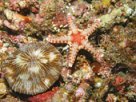 |
FROM Nigel Marsh. LOCATION: Puerto Galera, Philippines
ID - FAMILY: Ophidiasteridae COMMON NAME: Cummings sea star SCIENTIFIC NAME: Neoferdina cummingi REMARKS: Grows to around 60mm and is found across the Indo- pacific on both coral reefs and rocky reefs. Seen mostly at night, during the day they generally hide from the sun beneath dead coral slabs, in caves or underhangs. |
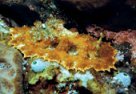 |
FROM Nigel Marsh. LOCATION: Puerto Galera, Philippines
ID - FAMILY: Chromodorididae COMMON NAME: Scallopededged ceratosoma SCIENTIFIC NAME: Ceratosoma miamirana REMARKS: Rarely seen by divers due to it's amazing camouflage colouration, this species ranges from the Red Sea to the Maldives, Indonesia, Japan, the Philippines and down to Australia and grows to around 80mm. A very beautiful and distinctive species and your image is excellent. |
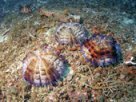 |
FROM Nigel Marsh. LOCATION: Puerto Galera, Philippines
ID - FAMILY: Echinothuridae COMMON NAME: Fire urchin SCIENTIFIC NAME: Asthenosoma varium REMARKS: There are several similar looking species within this genus. However, one thing they all have in common is their venom. A sting from any species will result in immediate pain, with bad stings taking some time to heal. It is generally found on sandy, muddy or rubble substrate and is extremely common at places in the Philippines. |
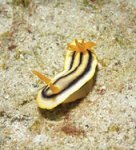 |
FROM Nigel Marsh. LOCATION: Puerto Galera, Philippines
ID - FAMILY: Chromodorididae COMMON NAME: Joshs chromodoris SCIENTIFIC NAME: Chromodoris joshi REMARKS: Found from the Philippines to at least Indonesia this species grows to 50mm and does not appear to be common in any one area. It's very distinctive colour pattern allows easy identification. |
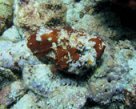 |
FROM Nigel Marsh. LOCATION: Puerto Galera, Philippines
ID - FAMILY: Scorpaenidae COMMON NAME: Devil scorpionfish SCIENTIFIC NAME: Scorpaenopsis diabolus REMARKS: This species can be distinguished by the pronounced hump on it's back. It grows to 18cm and can be found across the Indo-Pacific region. Very well camouflaged it sits almost motionless in the reef waiting for unwary fishes to come within range of it's lightning strike. |